Sunday, April 21, 2013

The Deaf-Blind Equipment Distribution Program - A Universal Approach.


I was on a working call this morning with Tracy Luiselli from the New England Deaf-Blind Center and of course we discussed the recent tragedy in Boston. Thankfully, Tracy and her family are safe. Sadly, there are those who perished in the bombing and those who were severely injured.

Tracy and I shared our sadness that our deaf-blind community, our country and our world have experienced so much sadness in recent years due to catastrophic events, some man-made and some caused by the force of nature. Of course we all know that we have lost too many beloved friends and colleagues in the deaf-blind community through accidents and illness.

It would be so easy for all of us to focus on the negative and allow it to become an excuse for not doing what we need to do and a reason to give up. However, I know that the deaf-blind community will not give up because there is so much to be done and despite the challenges so much to celebrate. 

I want to share with you a celebration that our project experienced ths past week-end at the Kentucky Association of the Deaf-Blind Annual Conference. I want to share this with you so that the celebration can continue for you and your constituents.

Much of the focus of our agenda was on technology. Marilyn Trader, our Helen Keller Regional Representative joined us and brought one of her colleagues, Sharon Giovinazzo from North Carolina. Both of these women have so much knowledge and expertise to share and it just so happens that both have incredible energy and passion for the work that they do.

They were here to assist consumers and staff with the Deaf-Blind Equipment Distribution Program. Many of the consumers attending live in more rural areas of our state and are older. Very, very few had a cell phone and none had an iPhone. To my knowledge, no one owns an iPad. Marilyn and Sharon were able to demonstrate the uses of items such as these and provide the consumers with an opportunity to practice using them. Representatives from Office for the Blind and Vocational Rehabilitation were there as well and will serve as follow-up support to the consumers.

The most awesome moment came when Sharon shared an app on her iPad that allowed the consumers to bring the evening sky (stars, moon, constellations) down to where they could see these things. The app works like a GPS system and when the iPad camera is turned up toward the sky an individual can see these things within arm's range. One comsumer with Usher Syndrome who is in his 50's could not remember what these things looked like from when he was a boy and started to weep when he saw the stars again after so many years. Another consumer with Usher Syndrome said, "My family sits out on the porch every night and when I ask them what they are doing they always say 'nothing' because they think I wouldn't be interested. Then they start talking about how many stars are in the sky and try to guess how many there are. I always tell them I don't know because I can't see them. Well .....  I can sure see them now!"

These are the moments that keep us motivated and keep us moving. These are the moments that are both profound and humbling for each of us.

Thank you so very, very much to those of you who were instrumental in securing funding for the Deaf-Blind Equipment Distribution Program.


Diane Haynes, M.Ed.
State Coordinator
Kentucky Deaf-Blind Project

Wednesday, April 3, 2013

Saturday, March 2, 2013

Haben Girma Writes at the White House Blog

Haben Girma is being honored as a Champion of Change for her efforts in Educational Excellence for African Americans.  Read her post "After Helen Keller: Empowering Students with Disabilities". 

Thursday, December 20, 2012

Early Identification - New Guide for States

The “sooner the better” has been a favorite phrase of mine since volunteering in a Head Start classroom when that program was just beginning. Starting early to improve results seemed like common sense and has been proven by longitudinal research to be true. We know that experiences during the earliest years of life critically impact a child’s ability to learn, move, and interact with others, and are particularly important for communication and language development.

Children with sensory challenges, additional disabilities and complex health needs face particular challenges and benefit from early intervention. This is especially true for young children with combined vision and hearing loss, for whom the world can be a very scary place.  State deaf-blind projects, a national family association and a network of professionals with specialized training are available to provide technical assistance to families, educators and caregivers of these children. However, the most recent data from the NCDB National Deaf-Blind Child Count indicate nearly twice as many children in the age 3- to 6-year-old category than the 0- to 3-year-old category, suggesting that many children who are deaf-blind are not identified as such, nor referred to state deaf-blind projects, until age 3 or older.

Since July, 2007 an NCDB work group has been working to form partnerships focused on improving the early identification and referral of infants and toddlers, birth through age two, with combined vision and hearing loss and I have been fortunate to be involved in those efforts. These efforts began with an extensive literature review, analysis of survey results and focus group interviews to learn about effective early identification and referral strategies being implemented by state deaf-blind projects that demonstrated success in identifying infants and toddlers. Continued work has concentrated on learning more from the broader early intervention community about evidence based early identification and referral practices, collecting resources developed by the deaf-blind network, and determining how to best share what we have learned.

All that work has paid off! NCDB’s Early Identification and Referral Initiative Team has just made available the Early Identification Self-Assessment and Referral Guide for use by state deaf-blind projects. The guide offers a data-based decision making process that includes data analysis, reflection on state systems serving children birth through two, and the development of an action plan to address any identified issues related to under-identification or under-referral. The Guide has been implemented as a pilot by ten state deaf-blind projects and includes a “toolbox” of great resources. The pilot states are ready and willing to share their experiences and the EI&R Team is available to provide technical assistance to any state project interested in completing the self-assessment process.

As someone who’s passionate about making sure little ones with combined vision and hearing loss – and their families – get connected as early as possible to the people and resources that can help I can’t think of a better holiday gift to share! Take a look at http://www.nationaldb.org/EarlyIdentificationInitiative.php and plan to join us on January 15 or 17 (2013) to learn more.

Barbara Purvis - NCDB

Thursday, December 6, 2012

Spirit of Partnership in Module Development


For many, December is a month of anticipation and giving.  It is a month full of preparation, the culmination of the work within a year and the sense that the New Year will soon begin.  Since NCDB was asked to create online, open-access modules that support the preparation and training of interveners, many partners in the Deaf-Blind Network have engaged with us to advise, co-create, and review the learning tools that are being developed.

In September, NCDB hosted several calls with members of the network to share and engage with the community in this important work. The discussions of the shared hopes for designing an open-access tool and the recognition that such tools should be used with integrity have helped shape our activities.

In October, nineteen representatives from our network, including parent leaders, university personnel preparation representatives, and state deaf-blind projects were invited to identify and prioritize the themes for the first modules under development.  Each person was invited because of rich experience in creating intervener preparation and training materials. At this meeting, a path was formed for building the first modules, developing practical learning scenarios, and aligning the modules with the CEC’s Knowledge and Skill Set for Paraeducators Who Are Interveners for Individuals with Deaf-blindness.

In November, twenty nine individuals participated in a module writing retreat to begin weaving together the videos, readings, and learning activities into compact, cogent learning modules that form the first four chapters in a larger narrative.  If you listen closely, you may even hear the module teams collaborating, sharing files, editing video and buzzing in the Adobe meeting rooms to complete the beta versions that will be tested in early February.

In keeping with the season of anticipation, many are wondering what the modules will contain. The themes which were born through the advisory committee work include:
  • ·         An overview of deaf-blindness and instructional strategies
  • ·         The sensory systems- eyes, ears, and brain
  • ·         The role of the intervener in the educational system
  • ·         Self-image and the importance of relationships
As exciting as the modular content may be, many have found that the true gifts of this process have come from the willingness to share the network’s best thinking, resources, and efforts to create a tool that may be shared by many.  Trying to build the “perfect tool” has been tempered by a sense of humor, the limitations of technology, and a desire to see the first modules come to fruition during this cycle of funding.

In one moment when the module teams were feeling particularly daunted by the task, Robbie Blaha, a module leader shared the lyrics of a Leonard Cohen song:

“Ring the bells that still can ring
Forget your perfect offering
There is a crack in everything
That's how the light gets in”

It is in that spirit that the module team process moves forward, readying for a field test of the beta versions of the modules in February and March that will shed more light on the practicality and usefulness of this community set of tools- a gift that reflects the efforts of a diverse community to share the best of what it knows- cracks and all.


Amy Parker - NCDB

Monday, November 19, 2012

National Child Count - Considerable in Relevance and History


The 2011 Deaf-Blind Child Count has just been published to the NCDB Website. You can find the report at: http://www.nationaldb.org/TAChildCount.php

This year’s report marks the 26th annual report published by NCDB and its’ predecessors on behalf of the state deaf-blind technical assistance projects.  It is the first and longest running registry and knowledge base of children who are deaf-blind in the world.  Begun in 1986 on behalf of the U.S. Department of Education (Baldwin, 1993), it represents a three decade  collaborative effort between the National Consortium on Deaf-Blindness (NCDB), its predecessors, and each state deaf-blind project throughout the country, as well as those projects funded in the Pacific Trust territories, the Virgin Islands and Puerto Rico.

Over time the child count has been collaboratively designed, implemented and revised to serve as the common vehicle to meet federal grant requirements for both the state/multi-state and national technical assistance projects.  It also has served as a common data collection and reporting mechanism for use across the country and to help identify national and state technical assistance needs for children and youth who are deaf-blind, their families and the service providers and systems which serve them (Killoran, 2007). Today, the Deaf-Blind Child Count summarizes, by state, information related to vision and hearing loss, etiology, age, gender, additional disabilities, education placement, participation in state assessment program, living setting and other variables providing a comprehensive picture of children and youth who are deaf-blind.

The child count was initially requested by the Department of Education to examine the discrepancy between the state/multi-state child counts and OSEP’s annual December 1 counts (Baldwin, 1993). The child count is conducted each year to supplement OSEP’s Federal Part C and Part B Child Counts (Special Education Child Count), which include children as deaf-blind only when deaf-blindness is their single disability. In contrast, the December 1 Deaf-Blind Child Count data is collected for children with deaf-blindness in isolation, as well as those with additional disabilities (Muller, 2006). This is an important distinction in that nearly 90% of the children and youth on the Deaf-Blind Child Count have one or more additional disabilities. Consequently, a majority of children who are deaf-blind or have deaf-blind intervention needs are not identified as such on OSEP’s Special Education Child Count.  For 2011, a total of 9,387 children and youth are included on the December 1 Deaf-Blind Child count.

In contrast, WESTAT (2012) reports that 1,587 students (3-21) were identified as deaf-blind on OSEP’s 12/1/11 Part B Special Education Child Count. Due to the non-categorical nature of Part C, no infants or toddlers are reported as deaf-blind since they are all reported as developmentally delayed or at-risk by their state Part C lead agencies (WESTAT, 2008). This 83.1% discrepancy between Part B and Part C reporting of children and youth who are deaf-blind and this nation Deaf-Blind Child Count is significant. State Deaf-Blind Project directors consistently indicate that most Part C lead agencies and State Education Agencies report their children and students with deaf-blindness as being developmentally delayed, multiply disabled, visually impaired or hearing impaired, rather than identifying them as deaf-blind. Concerns about the under-identification of deaf-blindness and its resulting unique intervention requirements has been a consistent problem and one which results in a lack of, or delay in receiving, appropriate intervention and instruction critical to children’s early development (Muller, 2006). The opportunity for early identification, intervention and the provision of instructional services aimed at the unique needs of young children and students who are deaf-blind is a critical component that cannot be lost.

In reviewing the child count data submitted over the years, it is clear that no single portrait can be painted to represent a typical child with deaf-blindness. Children who are deaf-blind are as varied as the number reported and the nature and extent of deaf-blindness in children is often misunderstood (Malloy & Killoran, 2007). These children represent one of the lowest incidence, yet most diverse group of learners receiving early intervention and special education services. They are an extremely heterogeneous group whose sensory losses may be accompanied by additional physical or cognitive disabilities, complex medical needs and/or behavior challenges (Muller, 2006).

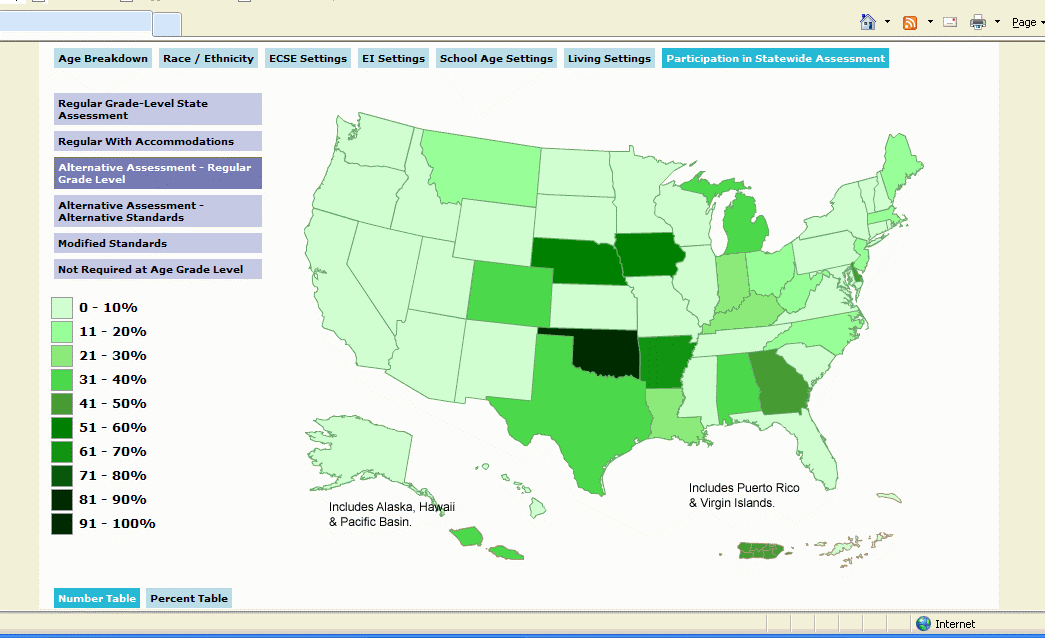
While you are on the Deaf-Blind Child Count page, also take the time to access the data maps that visually present state – by – state data on selected variables.  

Mark Schalock, NCDB 

References

Baldwin, V. (1993) Proceedings of the national symposium on children and youth who are deaf-blind.  Reiman, J. and Johnson, P., Editors, Monmouth, OR: DB-LINK, The Teaching Research Institute, Western Oregon University.

Malloy, P. &  Killoran, J. (2007). Children who are deaf blind.  Practice Perspectives - Highlighting Information on Deaf-Blindness. Monmouth, OR: National Consortium on Deaf-Blindness (NCDB), Teaching Research Institute, Western Oregon University. Available at: http://nationaldb.org/NCDBProducts.

Mueller, E. (2006). Deaf-blind child counts: issues and challenges.  Alexandria, VA: Project Forum at NASDSE. Available at: http://www.projectforum.org

WESTAT. (2012). Part B annual report tables. Retrieved September 2011 from http://www.IDEAdata.org

WESTAT. (2012). Part C annual report tables. Retrieved September 2011 from
http://www.IDEAdata.org 


Wednesday, October 31, 2012

Gloria from CDBS on the Ipad as an Informal Assessment Tool

As an educational specialist I make school and home visits to provide technical assistance to families and service providers.  On many recent home visits I have brought along the iPad to help me get a better idea of the child's interests and needs. I have found the iPad is a great informal assessment tool because 1) it's very interactive even for the child who has a very limited attention span, because if the child has enough vision to perceive what is on the screen, the child usually responds, 2) it’s fairly easy for the child to activate, 3) it can run apps that offer different degrees of complexity so I can meet the child at the level where the child is, and 4) with one device you can present information in different formats, e.g., from information that already comes in the apps to content that I can create on the spot, such as a photo of the child or a favorite family member to observe the child’s reaction. The iPad is like having a large bag full of all kinds of interactive things that I can show to the child, and best of all it comes in one thin and small portable device.
An important strategy that I follow when introducing the iPad and the different apps to the child is to bring the iPad close to the child and observe how the child responds - no grabbing hands, no making the child sit in a particular way - allowing the child to interact or not.  I then present the child with an app that I believe will be easy for the child to follow and engage with.  I observe what the child can do and how he or she looks at the screen, what kinds of images the child pays attention to, how the child interacts with the iPad, and how much time the child remains engaged. Finally I slowly increase the level of complexity of the apps and observe how far the child goes.
For young children or children with limited educational exposure you may want to check out the sequence to introduce apps based on sequential developmental stages Cristi Saylor and I wrote in the latest CDBS newsletter. The article is called "Using the iPad and a Sequence of Apps for Young Children with Multiple Disabilities." Here is the link: http://www.cadbs.org/newsletter/resources-fall-2012/

I would like to finish with an example from a recent visit with a young child. In this instance the little boy took a while before he started engaging with the iPad. Initially I was little surprised because I could see that he had some vision. After a while though he began to touch the screen with an object he had in his hand. Later he touched it with his own hand although he preferred only to watch. So I began with the apps in the first level of the sequence I mentioned earlier, where he only needed to look at high contrast images that moved without his needing to touch them. Eventually I moved to a slightly higher level where the child needed to touch the screen in a particular area where some characters appeared, but he was not very responsive. I concluded that he was was not yet able to distinguish gross details. When we were finished, the mother said that she had never seen her child engaged this long in an activity; we had played together for about twenty minutes. 

Gloria Rodriguez-Gil   California Deaf-Blind Services

Thursday, August 23, 2012

Gloria Rodgriguez-Gil: Deaf-Blind Virtual Community

In my last article “Beyond the Classroom and Into the School Community” I emphasized the need of viewing the school as much more than what is offered within the walls of each classroom and the limits of each role. Instead, it should be seen as a community where everyone supports the sense of belonging, education and socialization of all the students, including those students who are deaf-blind. The pursuit of this vision is to maximize resources and opportunities for all by forming and strengthening the school community.

This vision of community comes to mind as I began using “Deaf-Blind Network Connections.” This is a new virtual community sponsored by the National Consortium on Deaf-Blindness (NCDB).

Encouraged by The Office of Special Education Programs (OSEP), NCDB created this network to enable them and the state deaf-blind projects to share resources, thoughts, needs, knowledge and experience with the goal of improving the services that we provide to students who are deaf-blind and their families.

This virtual network has the capability to distribute resources more evenly and therefore benefit more people.  Enhancing this democratic effect, participants will have the opportunity to engage in a virtual sphere beyond the boundaries of their customary role in the deaf-blind project or the constraints of a project’s budget.  Further, collaboration can occur according to each participant’s own scheduling needs.  As Jon Harding explained in his webinar, participation can be “synchronous” (at the same time with others) or “asynchronous” (on one’s own time) creating a community that can be accessed 24/7.

This kind of collaboration is not new. It has been managed over the years through such things as area meetings, listservs, communities of practice, project director’s meetings, and topical conferences. But now we are going a step further, utilizing increasingly interactive technology to break down the barriers created by the borders of each state, institution and, I would add, of each individual, in order to maximize our great potential.

So the platform is there. Now the challenge will be for staff to actively participate in the network so that many voices can be included in its fabric.   Without participation there is no community, and all those benefits never get realized. The link to our Deaf-Blind Network Connections can be found at http://network.nationaldb.org/

Gloria Rodriguez-Gil   California Deaf-Blind Services

Wednesday, July 25, 2012

NCDB Publishes Recommendations for Intervener Services

NCDB's Recommendations for Improving Intervener Services were recently completed and are available at interveners.nationaldb.org.  NCDB developed these recommendations in response to a request from the Department of Education’s Office of Special Education Programs (OSEP). 

The development of the recommendations was preceded by in-depth data collection about the current status of intervener services in the U.S., including the accomplishments of those who have worked diligently to advance the practice of intervener services over the past several decades.  Many people who are involved in the lives of children and youth who are deaf-blind assisted us during this process by participating in surveys, interviews, and panel discussions and we are deeply grateful to everyone who was involved.

We invite you to share your thoughts and perspectives on these recommendations either by contacting NCDB directly or by joining our new online forum and posting your comments at http://network.nationaldb.org/.

Posted by Peggy Malloy, NCDB

Thursday, July 12, 2012

Quick Tips for Hassle Free Video


Recently, I attended a workshop titled “How to Shoot Video Like a Pro.” The first 45 minutes of the 90 minute workshop discussed how to hire a producer and director, how to find “talent,” and setting up a boom mic and camera dolly.

In most cases when shooting video for technical assistance purposes, you will not need to produce a high quality video, nor have the opportunity to do several “takes.” Here are some basic tips I have found helpful to increase my chances of getting it right the first time.

Lighting
I always try to be aware of my light source. Light originating behind my subject will make them too dark.

Sound
I test the sound in the room by standing at a distance and walking toward the camcorder, while it is recording, and reciting a passage at a constant volume. This tells me the best distance for recording and sometimes informs me of background noise I hadn’t noticed.

Camera position
When applicable, I use a tripod to prevent excess movement and I always try to choose an angle that best captures my objectives.

Length of video
Remember, 5 minutes is considered a very long time to watch video. Three minutes or less is ideal. I often times break long videos into vignettes.

Know your camera
I like to keep a crib sheet of the control buttons, for the functions I know I will need.

Be prepared
Making sure the battery is fully charged (including a spare), having extra storage media, and a lens cloth for that inevitable smudge are essential for minimizing surprises.

If you have some favorite tips, please take a moment to share them with the rest of us.

See our brief, Considerations for Creating Video Clips for Technical Assistance  for more detailed guidelines on capturing quality videos.

Posted by Randy Klumph, NCDB

Monday, June 18, 2012

Ways to Use Video to Enhance TA


At NCDB, we have been working with state deaf-blind projects to promote the use of video in technical assistance (TA). While video can be used in a variety of ways, we see the potential for video to empower and engage parents.

Sharing video clips of classroom routines and interactions can be a way to build rapport with parents who may feel disengaged or removed from classroom activities. Video clips offer parents the opportunity to view positive interactions between staff and their child and to present the dynamics of typical classroom practices and activities. In essence, video clips can be a portal through which parents can observe their children in settings that are often hidden from view. Video clips can open new avenues for dialogue, and can empower parents to take a more active role in their child’s daily classroom life.

Let us know your experiences with video and how it has enhanced parents’ roles in their children’s education. Has it impacted family perceptions of schools? Are schools comfortable sharing daily activities with parents via video? How can we use video to build trust and rapport between parents and schools? We’ll use the comments section below to track your comments.
The accompanying brief “Ways to Use Video to Enhance TA” addresses some of the ways projects might use video as part of their TA repertoire.   View the brief.

Posted by Jon Harding, NCDB

Wednesday, March 7, 2012

Apps and Resources for Young Children with Special Needs

Gloria Rodriguez-Gil from CA Deaf-Blind Services reports on her experiences using the iPad with students who are deaf-blind, deaf, and hard of hearing with special needs.

Read post: http://www.cadbs.org/news/gloria-apps-and-resources-for-young-children-with-special-needs/

High Touch and Low Incidence - What I have learned from the Deafblind Census

Jim Durkel from Texas writes about access and support for children who are deaf-blind.


In a conversation I had with Jay Gense, director of the National Consortium on Deaf-Blindness (NCDB), he estimated the incidence of deafblindness for children and youth birth to 22 years old in the United States is around .01%.
The incidence in Texas is slightly higher at about .017%.  This means that out of the 4 million plus students in public education in Texas, around 750 are identified as having both hearing and vision problems.  More

Thursday, February 16, 2012

Distance Mentorship Project and the "New Normal"

Jon Harding, NCDB


The phrase “new normal” is uttered a lot these days, and we worry what it actually means for those of us who work in the Deaf-Blind Technical Assistance network.  The “new normal” is often used to describe ongoing changes in our culture, our economy, and our political systems, but it can also apply to our small corner of the world, too.  For state deaf-blind projects and NCDB 2.0, operating in the “new normal” means that while we continue to strive to improve outcomes for children and their families,  ongoing changes often affect our level of resource.  We find ourselves having to do more or do different with less money, time, and/or staff. However, this is also an opportunity to reassess how we allocate our resources and to clarify our mission.  The values that underpin our TA behaviors and practices as TA providers (relationships, communication, self-determination, personal growth, education, respect, choice, inclusion, empowerment, and self-fulfillment) should not change.  The debate is not what we want to achieve but, rather, how to achieve it.  Technology can be the vehicle to produce child and family outcomes in a more efficient way.  

The “Old Way”:
While State Deaf-Blind Technical Assistance Projects are diverse, they have traditionally used a model of TA that relies heavily on in-person trainings, workshops, and conferences to create change and build the capacity of “systems” to serve the needs of our children and families (and honor our core values).  These trainings typically consist of training materials, videos, assessments, and/or curriculum that are shared by a speaker, facilitator, and/or recognized ‘expert’ from the field.  Participants are typically teachers, paraprofessionals, related service providers, family members, administrators, etc.  In this context, projects expect and hope that workshop participants implement the strategies and practices with individual children and families that are being extolled in the workshops.  

Most projects, too, have some element of on-site or one-to-one technical assistance as part of their repertoire.  Some projects contract with outreach consultants who have been trained in some elements of deaf-blindness.  The consultants might serve a geographic region or neighboring school districts.  Often project employees serve as consultants who confer with teachers and/or teams by phone or on-site. 

“Old Way” challenges:
  • Implementation and measuring change:
Projects need to demonstrate accountability for their efforts by collecting and reporting impact data (ie:  what changed as a result of our efforts?).  However, measuring changes in behavior subsequent to workshops, sporadic on-site visits, or episodic phone consults has been problematic.  Projects rely on self-reporting and perception to measure behavioral changes in either the service provider or the child.  Documenting behavior change over a period of time (weeks, months, or even years) is an even bigger challenge.  Modeling, checking for understanding, and guided practice (Madeline Hunter concepts) are typically absent in this traditional model of TA.
  • On going support:
Even highly trained, experienced, and motivated teachers need support when working with children who are complex.  Unfortunately, most teachers and providers working with children who are deaf-blind receive little or no training before being hired or prior to a child being placed in his/her class.  Attending a one or two-day workshop is often a respite and certainly can provide relevant information, but it is unlikely to induce changes in teaching behavior.  In the same way, even the most highly skilled consultant will find it difficult to compel changes in behavior as a result of infrequent one-to-one contacts. 
  • Building capacity:
Good TA providers know the answers to the challenges presented by children with complex needs are most likely to be solved by the team members themselves.  While almost every school serving a child who is deaf-blind embraces the “teaming” concept, what we often find is confusion, indecision, uncoordinated services, and a lack of communication among the different specialty staff.   Adding a deaf-blind project consultant to the mix on a one-time or intermittent basis rarely solves this dilemma and can, in fact, exacerbate any confusion team members feel.
  • Cost:
By almost any measure, on-site technical assistance is expensive.  Travel costs typically involve paying for transportation, food, and sometimes lodging.  Few would advocate eliminating on-site TA entirely, for there are clear benefits to meeting in person.  Project staff will have to assess the cost/benefit of all TA activities in the context of their budgets, but we must acknowledge the costs for on-site TA are unlikely to fall.  

One “New Way”
The Distance Mentorship Program (DMP) was developed in response to the challenges mentioned above.  The model has been described in the Deaf-Blind Perspectives article, Making Online TechnicalAssistance Connections While it can be argued that using the DMP model can reduce costs, it may not be the most important reason to use it.  Perhaps the most compelling reason to adopt a model that allows TA to be delivered remotely is that it can increase communication within the local team and with consultants over an extensive period of time.  Ultimately, the implementation of strategies that are documented, and the resulting changes in behaviors can become the foundation for the local team to extend and increase their skills with other students and in other environments.  An online, permanent electronic repository of videos, resources, and conversations can be shared with other professionals as the child transitions to new settings.  

The DMP allows consultants to meet regularly with providers and to engage in the struggles that present themselves throughout a school year.  Providers often appreciate the freedom to adapt their strategies, to acknowledge their fears, and to try “fun” activities that may not have an obvious connection to state standards, assessment measures, or standard grade-level curriculum.  Consultants and providers can build a relationship based on trust and respect in ways that is impossible with episodic or one-time on-site visits.

It is important to state that the DMP is simply one model that can be utilized to deliver intensive, specific TA targeting both service provider changes as well as child and family outcomes.  This model can and should be seen as a compliment to other systemic efforts that attempt to build capacity and improve outcomes:  personnel preparation, intervener training, research, and effective TA systems. 

The “new normal” demands new, innovative ways to deliver services that result in improved child and family outcomes, but also align with our larger values and principles.  The Distance Mentorship model is one way to alleviate our fears about the “new normal”. 

Tuesday, February 7, 2012

Jan van Dijk's Child-Centered Assessment

Gloria Rodgriguez-Gil from CA Deaf-Blind Services reports on van Dijk's presentation at the 16th Annual Lowenfeld-Akeson Early Years Symposium.  He spoke on his assessment approach with children with multiple disabilities.

Wednesday, September 28, 2011

Using the Deaf-Blind Child Count Maps and Pivot Tables Together

Posted by Mark Schalock  - NCDB

As we post the Deaf-Blind Child Count for 2010, it seems a good time to revisit the tools available through NCDB to delve deeper into the Child Count data.  A year ago, in June 2010, NCDB hosted a webinar on the newly created Child Count Data Maps and the updated Pivot Tables/Charts.[1] This blog entry is intended to provide some ideas and strategies on how to use the tools in concert to maximize each tool’s capabilities.

Each tool has different strengths that can easily be exploited to provide you with very specific information.  The Data Maps are perfect for seeing the big picture and identifying states with similar characteristics. The Pivot Charts/Tables are better suited to delving down in to the data to find specific patterns.

For example, you are in Nebraska and are interested in providing professional development on administering alternative assessments tied to regular grade level standards. You might was to identify other states that have similar patterns of children taking regular grade level alternative state assessments to talk with your colleagues about what they have done in this area. To do this, you can select this option on the data mapping tool and see which other states are similar. The map below shows that there are a number of other states in the region that have a similar pattern: Iowa, Colorado, Oklahoma, and Arkansas. Using the data map provides a quick, visual summary of this query.


[1] An archived version of this webinar can be accessed at: http://www.nationaldb.org/NCDBProducts.php?prodID=121


Switching now to the Pivot Tables/Charts, you can select just these states to conduct additional analyses around state assessments. For example, you are especially interested in the professional development targeting middle school and high school age students. You also want to know whether educational placement is in any way related to type of assessment. In Excel 2007, you can select just those states, age ranges and type of assessment by filtering each of these variables.

To select specific states, click on State in the Pivot Table Field List (see below), un-click “all” and then check those states you want to include. Next, select State Assessment and select the option of alternative assessment regular grade level standards. Finally, select Age Group and select the school age groups of “6-11”, “12-17” and “18-21.” You now can compare yourself to your neighbor states. You will see that like most of the states, the largest group of children/youth taking alterative assessments tied to regular grade level standards is in middle and high school. Arkansas is the exception, where the largest group is at the elementary level. Thus, contacting Colorado, Iowa and Oklahoma would be indicated.


To see whether these is a difference by educational setting, move Age Group and State Assessment back up into the Pivot Table Field List pane and move Educational Setting into the Legend Field pane after selecting just the school age settings (see below). You will notice that the age group and state assessment filters will remain in effect.

As expected, the largest group of children/youth in school age special education taking alternative assessments tied to regular grade level standards, is in regular classrooms less than 40% of the day. This is expected because this is the most common overall education setting. However, Oklahoma and Arkansas are the only other states with children/youth in Homebound/Hospital settings who are taking alternative assessment tied to regular grade level standards. You might want to contact colleagues in these states if a Homebound/Hospital setting is important.


This example is simply designed to show how you can use both the Data Mapping tool and the Pivot Table/Charts together to address any number of questions or issues.

You can access the Data Maps at: http://www.nationaldb.org/censusMaps.php

If you have not already downloaded the Pivot Tables/Charts, please contact us and we will provide the information needed to do so.

For more information or help, please contact Mark Schalock at schalom@wou.edu
Or at (503) 838-8777.


Thursday, August 18, 2011

In DC for 2011 OSEP/NCDB/State Deaf-Blind Projects Meeting


Posted by John Reiman - NCDB

                 On Sunday, July 17, the annual OSEP/NCDB/State Deaf-Blind Projects Meeting was held in Washington, DC.  Titled ‘Enhancing Deaf-Blind Network Connectivity: Applications of Web Technology’, the day provided an opportunity for NCDB and states to collaboratively brainstorm around the use of web-based technologies to increase connectivity, productivity and network-wide dialogue. Following an overview of the day’s objectives and activities, the Meeting began with presentations on two targeted high-need content areas (Central Auditory Processing Disorder, and Regional State Deaf-Blind Project Consultation/TA Models). Next, focusing on these (and several additional) focal areas, NCDB staff presented/demonstrated a menu of web-based systems and strategies for information sharing, access to materials, and shared dialogue. The final and culminating activity of the day divided participants (n=110) into four facilitated discussion groups that addressed questions related to their: (a) “big picture” thoughts and reactions to the day’s emphasis on networking/technology, (b) perceived benefit in becoming a more interdependent Deaf-Blind Project Network, (c) interests in particular features of presented technologic tools, and (d) needs (e.g., supports, training, etc.) in order to participate fully in the network. Tentative analysis of data recorded from the group sessions indicated that participants: (1) valued the information presented on both targeted topics; (2) saw great potential for heightened collaboration through enhanced use of technology; (3) identified challenges and possible solutions related to technologic tool familiarity, mastery and implementation; (4) valued continuing thoughtfulness about how we proceed with application of technology as a community; (5) welcomed ongoing training, coaching and support  in forward movement. 

NCDB is excited about participants’ recognized value of uses of technologies across the network to continue the dialogue(s), strengthen the network, and ultimately, provide everyone with enhanced opportunities to work together. The uses of technology are clearly a focus area for OSEP’s current and future investments, and the deaf-blind network is well poised to capitalize on the established momentum.

If you are interested in the materials presented at the meeting you can find them posted to either of two Wiggio sites that were featured in the demonstration of tools.  Check out the Wiggio sites for CAPD and AuditoryNeuropathy  or Regional DB Consultant.  Once you set up your account you can find materials and post your comments.

Friday, August 5, 2011

Youth Pathway to Independence:Next Stop AADB!

Blog Posted by Mike Fagbemi    NCDB

The opening ceremony of the American Association for the Deaf-Blind (AADB) symposium held in Fort Mitchell, Kentucky this past June, celebrated the gathering of approximately 150 delegates and 350 support service providers (SSPs). The delegates, representing the national and international deaf-blind community, embraced the themes of the symposium—technology, SSPs, employment, and leadership. In addition, with its commitment to national issues affecting the DB community, and a renewed focus on professional networking, AADB was proud to invite ten young adults ages 16 to 22 years old to participate in the symposium.

The young adults had access to the main symposium, but they and their family members also participated in a family and youth program coordinated by the National Consortium on Deafblindness and the Florida state deaf-blind project, in collaboration with the Georgia and Texas state deaf-blind projects. The youth program included strands focusing on career development, job readiness, and self-advocacy. Families benefited from a separate and complimentary program on self-empowerment, effective communication, and their shared experiences as family members who play active roles in the development and maturity of a young person with deaf-blindness.

The ten young adults, representing eight states, all had an interest in developing skills to become more self-determined which they agreed would improve their academic success and employment opportunities. Some were still in high school and making plans to enroll in community colleges, while others shared a desire to be prepared for the competitive workforce through early exposure to a variety of career possibilities. Austin Nix, a participant from Mississippi stated, “The family and youth program was such a unique experience for me to learn new things about careers, finding work that interests me, and what good work etiquette means. At the same time it was nice to meet new people with similar interests and goals for me to learn from.”

The youth strand had many different layers, but probably the most important aspect of all was the role that three youth mentors played. The mentors were all former participants in annual southeast regional youth workshops. They had benefited from their experiences and demonstrated the skill and knack needed to energize, educate, and inspire other young people transitioning to adult life. The mentors were invited to be part of the core of the planning committee to develop the content and activities of the youth program and to give presentations. The success of this symposium was a direct result of their active involvement and the infusion of their ideas resonated well with the young people who were engaged in every activity.

The young adults who participated in the program had personality, flair, and interesting perspectives that impressed many symposium participants, including AADB board members and national partners representing Bookshare, PEPNet, the Helen Keller National Center, and vocational rehabilitation services. The program exposed the young adults to a myriad of careers currently held by various professionals who are deaf-blind. At one point, during a presentation by Judy Groner a self-employed business owner who customizes bird houses, one of the youth participants blurted out “Wow! I never knew we could even own our own business. I want to do something like that. All I need is a good idea for people in my small town to like!” It became clear to me and to the other people in the room that this was a turning point for many of the participants. They seemed to gain confidence as each presenter shared their experiences as volunteers, professionals, liaisons to federal disability agencies, technology gurus from HKNC, and advocates from Deaf-Blind Youth in Action. The icing on the cake was presentations given by the youth mentors! The young adult participants left the symposium with tools gained through interactive experiences with presenters and each other. Many had never considered a career or interviewed for work. Many had not thought about deaf-blindness as a disability of access and how it could impact their college and work experiences. Lastly, many did not know that their community was rich with leaders and youth mentors who are on their own personal journeys to achieve their dreams. The opportunity to learn together and grow while forging networks seemed to be the glue that bonded these themes of the symposium together. On this journey, the professionals who participated in the youth program learned quite a bit from the young people, and their parents and siblings who accompanied them. There were many “Aha!” moments. I expect that we have not heard the last of the young people who attended this national symposium. It will not be long before each of them are educating, energizing, and inspiring others as well.