Read post: http://www.cadbs.org/news/gloria-apps-and-resources-for-young-children-with-special-needs/
Wednesday, March 7, 2012
Apps and Resources for Young Children with Special Needs
Gloria Rodriguez-Gil from CA Deaf-Blind Services reports on her experiences using the iPad with students who are deaf-blind, deaf, and hard of hearing with special needs.
Read post: http://www.cadbs.org/news/gloria-apps-and-resources-for-young-children-with-special-needs/
Read post: http://www.cadbs.org/news/gloria-apps-and-resources-for-young-children-with-special-needs/

High Touch and Low Incidence - What I have learned from the Deafblind Census
Jim Durkel from Texas writes about access and support for children who are deaf-blind.
In a conversation I had with Jay Gense, director of the National Consortium on Deaf-Blindness (NCDB), he estimated the incidence of deafblindness for children and youth birth to 22 years old in the United States is around .01%.
The incidence in Texas is slightly higher at about .017%. This means that out of the 4 million plus students in public education in Texas, around 750 are identified as having both hearing and vision problems. More
In a conversation I had with Jay Gense, director of the National Consortium on Deaf-Blindness (NCDB), he estimated the incidence of deafblindness for children and youth birth to 22 years old in the United States is around .01%.
The incidence in Texas is slightly higher at about .017%. This means that out of the 4 million plus students in public education in Texas, around 750 are identified as having both hearing and vision problems. More
Thursday, February 16, 2012
Distance Mentorship Project and the "New Normal"
Jon Harding, NCDB
The phrase “new normal” is uttered a lot these days, and we worry what it actually means for those of us who work in the Deaf-Blind Technical Assistance network. The “new normal” is often used to describe ongoing changes in our culture, our economy, and our political systems, but it can also apply to our small corner of the world, too. For state deaf-blind projects and NCDB 2.0, operating in the “new normal” means that while we continue to strive to improve outcomes for children and their families, ongoing changes often affect our level of resource. We find ourselves having to do more or do different with less money, time, and/or staff. However, this is also an opportunity to reassess how we allocate our resources and to clarify our mission. The values that underpin our TA behaviors and practices as TA providers (relationships, communication, self-determination, personal growth, education, respect, choice, inclusion, empowerment, and self-fulfillment) should not change. The debate is not what we want to achieve but, rather, how to achieve it. Technology can be the vehicle to produce child and family outcomes in a more efficient way.
The “Old Way”:
While State Deaf-Blind Technical Assistance Projects are diverse, they have traditionally used a model of TA that relies heavily on in-person trainings, workshops, and conferences to create change and build the capacity of “systems” to serve the needs of our children and families (and honor our core values). These trainings typically consist of training materials, videos, assessments, and/or curriculum that are shared by a speaker, facilitator, and/or recognized ‘expert’ from the field. Participants are typically teachers, paraprofessionals, related service providers, family members, administrators, etc. In this context, projects expect and hope that workshop participants implement the strategies and practices with individual children and families that are being extolled in the workshops.
Most projects, too, have some element of on-site or one-to-one technical assistance as part of their repertoire. Some projects contract with outreach consultants who have been trained in some elements of deaf-blindness. The consultants might serve a geographic region or neighboring school districts. Often project employees serve as consultants who confer with teachers and/or teams by phone or on-site.
“Old Way” challenges:
- Implementation and measuring change:
Projects need to demonstrate accountability for their efforts by collecting and reporting impact data (ie: what changed as a result of our efforts?). However, measuring changes in behavior subsequent to workshops, sporadic on-site visits, or episodic phone consults has been problematic. Projects rely on self-reporting and perception to measure behavioral changes in either the service provider or the child. Documenting behavior change over a period of time (weeks, months, or even years) is an even bigger challenge. Modeling, checking for understanding, and guided practice (Madeline Hunter concepts) are typically absent in this traditional model of TA.
- On going support:
Even highly trained, experienced, and motivated teachers need support when working with children who are complex. Unfortunately, most teachers and providers working with children who are deaf-blind receive little or no training before being hired or prior to a child being placed in his/her class. Attending a one or two-day workshop is often a respite and certainly can provide relevant information, but it is unlikely to induce changes in teaching behavior. In the same way, even the most highly skilled consultant will find it difficult to compel changes in behavior as a result of infrequent one-to-one contacts.
- Building capacity:
Good TA providers know the answers to the challenges presented by children with complex needs are most likely to be solved by the team members themselves. While almost every school serving a child who is deaf-blind embraces the “teaming” concept, what we often find is confusion, indecision, uncoordinated services, and a lack of communication among the different specialty staff. Adding a deaf-blind project consultant to the mix on a one-time or intermittent basis rarely solves this dilemma and can, in fact, exacerbate any confusion team members feel.
- Cost:
By almost any measure, on-site technical assistance is expensive. Travel costs typically involve paying for transportation, food, and sometimes lodging. Few would advocate eliminating on-site TA entirely, for there are clear benefits to meeting in person. Project staff will have to assess the cost/benefit of all TA activities in the context of their budgets, but we must acknowledge the costs for on-site TA are unlikely to fall.
One “New Way”
The Distance Mentorship Program (DMP) was developed in response to the challenges mentioned above. The model has been described in the Deaf-Blind Perspectives article, Making Online TechnicalAssistance Connections . While it can be argued that using the DMP model can reduce costs, it may not be the most important reason to use it. Perhaps the most compelling reason to adopt a model that allows TA to be delivered remotely is that it can increase communication within the local team and with consultants over an extensive period of time. Ultimately, the implementation of strategies that are documented, and the resulting changes in behaviors can become the foundation for the local team to extend and increase their skills with other students and in other environments. An online, permanent electronic repository of videos, resources, and conversations can be shared with other professionals as the child transitions to new settings.
The DMP allows consultants to meet regularly with providers and to engage in the struggles that present themselves throughout a school year. Providers often appreciate the freedom to adapt their strategies, to acknowledge their fears, and to try “fun” activities that may not have an obvious connection to state standards, assessment measures, or standard grade-level curriculum. Consultants and providers can build a relationship based on trust and respect in ways that is impossible with episodic or one-time on-site visits.
It is important to state that the DMP is simply one model that can be utilized to deliver intensive, specific TA targeting both service provider changes as well as child and family outcomes. This model can and should be seen as a compliment to other systemic efforts that attempt to build capacity and improve outcomes: personnel preparation, intervener training, research, and effective TA systems.
The “new normal” demands new, innovative ways to deliver services that result in improved child and family outcomes, but also align with our larger values and principles. The Distance Mentorship model is one way to alleviate our fears about the “new normal”.
Tuesday, February 7, 2012
Jan van Dijk's Child-Centered Assessment
Gloria Rodgriguez-Gil from CA Deaf-Blind Services reports on van Dijk's presentation at the 16th Annual Lowenfeld-Akeson Early Years Symposium. He spoke on his assessment approach with children with multiple disabilities.
Wednesday, September 28, 2011
Using the Deaf-Blind Child Count Maps and Pivot Tables Together
Posted by Mark Schalock - NCDB
As we post the Deaf-Blind Child Count for 2010, it seems a good time to revisit the tools available through NCDB to delve deeper into the Child Count data. A year ago, in June 2010, NCDB hosted a webinar on the newly created Child Count Data Maps and the updated Pivot Tables/Charts.[1] This blog entry is intended to provide some ideas and strategies on how to use the tools in concert to maximize each tool’s capabilities.
Each tool has different strengths that can easily be exploited to provide you with very specific information. The Data Maps are perfect for seeing the big picture and identifying states with similar characteristics. The Pivot Charts/Tables are better suited to delving down in to the data to find specific patterns.
For example, you are in Nebraska and are interested in providing professional development on administering alternative assessments tied to regular grade level standards. You might was to identify other states that have similar patterns of children taking regular grade level alternative state assessments to talk with your colleagues about what they have done in this area. To do this, you can select this option on the data mapping tool and see which other states are similar. The map below shows that there are a number of other states in the region that have a similar pattern: Iowa, Colorado, Oklahoma, and Arkansas. Using the data map provides a quick, visual summary of this query.

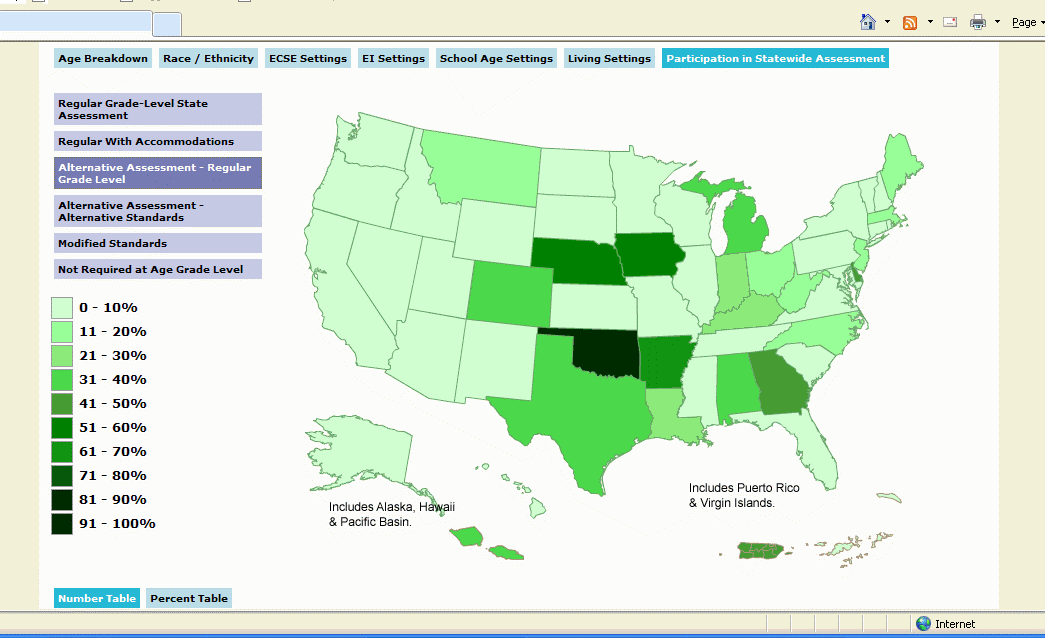
[1] An archived version of this webinar can be accessed at: http://www.nationaldb.org/NCDBProducts.php?prodID=121


Switching now to the Pivot Tables/Charts, you can select just these states to conduct additional analyses around state assessments. For example, you are especially interested in the professional development targeting middle school and high school age students. You also want to know whether educational placement is in any way related to type of assessment. In Excel 2007, you can select just those states, age ranges and type of assessment by filtering each of these variables.
To select specific states, click on State in the Pivot Table Field List (see below), un-click “all” and then check those states you want to include. Next, select State Assessment and select the option of alternative assessment regular grade level standards. Finally, select Age Group and select the school age groups of “6-11”, “12-17” and “18-21.” You now can compare yourself to your neighbor states. You will see that like most of the states, the largest group of children/youth taking alterative assessments tied to regular grade level standards is in middle and high school. Arkansas is the exception, where the largest group is at the elementary level. Thus, contacting Colorado, Iowa and Oklahoma would be indicated.

To see whether these is a difference by educational setting, move Age Group and State Assessment back up into the Pivot Table Field List pane and move Educational Setting into the Legend Field pane after selecting just the school age settings (see below). You will notice that the age group and state assessment filters will remain in effect.
As expected, the largest group of children/youth in school age special education taking alternative assessments tied to regular grade level standards, is in regular classrooms less than 40% of the day. This is expected because this is the most common overall education setting. However, Oklahoma and Arkansas are the only other states with children/youth in Homebound/Hospital settings who are taking alternative assessment tied to regular grade level standards. You might want to contact colleagues in these states if a Homebound/Hospital setting is important.

This example is simply designed to show how you can use both the Data Mapping tool and the Pivot Table/Charts together to address any number of questions or issues.
You can access the Data Maps at: http://www.nationaldb.org/censusMaps.php
If you have not already downloaded the Pivot Tables/Charts, please contact us and we will provide the information needed to do so.
For more information or help, please contact Mark Schalock at schalom@wou.edu
Or at (503) 838-8777.
Thursday, August 18, 2011
In DC for 2011 OSEP/NCDB/State Deaf-Blind Projects Meeting
Posted by John Reiman - NCDB
On Sunday, July 17, the annual OSEP/NCDB/State Deaf-Blind Projects Meeting was held in Washington, DC. Titled ‘Enhancing Deaf-Blind Network Connectivity: Applications of Web Technology’, the day provided an opportunity for NCDB and states to collaboratively brainstorm around the use of web-based technologies to increase connectivity, productivity and network-wide dialogue. Following an overview of the day’s objectives and activities, the Meeting began with presentations on two targeted high-need content areas (Central Auditory Processing Disorder, and Regional State Deaf-Blind Project Consultation/TA Models). Next, focusing on these (and several additional) focal areas, NCDB staff presented/demonstrated a menu of web-based systems and strategies for information sharing, access to materials, and shared dialogue. The final and culminating activity of the day divided participants (n=110) into four facilitated discussion groups that addressed questions related to their: (a) “big picture” thoughts and reactions to the day’s emphasis on networking/technology, (b) perceived benefit in becoming a more interdependent Deaf-Blind Project Network, (c) interests in particular features of presented technologic tools, and (d) needs (e.g., supports, training, etc.) in order to participate fully in the network. Tentative analysis of data recorded from the group sessions indicated that participants: (1) valued the information presented on both targeted topics; (2) saw great potential for heightened collaboration through enhanced use of technology; (3) identified challenges and possible solutions related to technologic tool familiarity, mastery and implementation; (4) valued continuing thoughtfulness about how we proceed with application of technology as a community; (5) welcomed ongoing training, coaching and support in forward movement.
NCDB is excited about participants’ recognized value of uses of technologies across the network to continue the dialogue(s), strengthen the network, and ultimately, provide everyone with enhanced opportunities to work together. The uses of technology are clearly a focus area for OSEP’s current and future investments, and the deaf-blind network is well poised to capitalize on the established momentum.
Friday, August 5, 2011
Youth Pathway to Independence:Next Stop AADB!
Blog Posted by Mike Fagbemi NCDB
The opening ceremony of the American Association for the Deaf-Blind (AADB) symposium held in Fort Mitchell, Kentucky this past June, celebrated the gathering of approximately 150 delegates and 350 support service providers (SSPs). The delegates, representing the national and international deaf-blind community, embraced the themes of the symposium—technology, SSPs, employment, and leadership. In addition, with its commitment to national issues affecting the DB community, and a renewed focus on professional networking, AADB was proud to invite ten young adults ages 16 to 22 years old to participate in the symposium.
The young adults had access to the main symposium, but they and their family members also participated in a family and youth program coordinated by the National Consortium on Deafblindness and the Florida state deaf-blind project, in collaboration with the Georgia and Texas state deaf-blind projects. The youth program included strands focusing on career development, job readiness, and self-advocacy. Families benefited from a separate and complimentary program on self-empowerment, effective communication, and their shared experiences as family members who play active roles in the development and maturity of a young person with deaf-blindness.
The ten young adults, representing eight states, all had an interest in developing skills to become more self-determined which they agreed would improve their academic success and employment opportunities. Some were still in high school and making plans to enroll in community colleges, while others shared a desire to be prepared for the competitive workforce through early exposure to a variety of career possibilities. Austin Nix, a participant from Mississippi stated, “The family and youth program was such a unique experience for me to learn new things about careers, finding work that interests me, and what good work etiquette means. At the same time it was nice to meet new people with similar interests and goals for me to learn from.”
The youth strand had many different layers, but probably the most important aspect of all was the role that three youth mentors played. The mentors were all former participants in annual southeast regional youth workshops. They had benefited from their experiences and demonstrated the skill and knack needed to energize, educate, and inspire other young people transitioning to adult life. The mentors were invited to be part of the core of the planning committee to develop the content and activities of the youth program and to give presentations. The success of this symposium was a direct result of their active involvement and the infusion of their ideas resonated well with the young people who were engaged in every activity.
The young adults who participated in the program had personality, flair, and interesting perspectives that impressed many symposium participants, including AADB board members and national partners representing Bookshare, PEPNet, the Helen Keller National Center, and vocational rehabilitation services. The program exposed the young adults to a myriad of careers currently held by various professionals who are deaf-blind. At one point, during a presentation by Judy Groner a self-employed business owner who customizes bird houses, one of the youth participants blurted out “Wow! I never knew we could even own our own business. I want to do something like that. All I need is a good idea for people in my small town to like!” It became clear to me and to the other people in the room that this was a turning point for many of the participants. They seemed to gain confidence as each presenter shared their experiences as volunteers, professionals, liaisons to federal disability agencies, technology gurus from HKNC, and advocates from Deaf-Blind Youth in Action. The icing on the cake was presentations given by the youth mentors! The young adult participants left the symposium with tools gained through interactive experiences with presenters and each other. Many had never considered a career or interviewed for work. Many had not thought about deaf-blindness as a disability of access and how it could impact their college and work experiences. Lastly, many did not know that their community was rich with leaders and youth mentors who are on their own personal journeys to achieve their dreams. The opportunity to learn together and grow while forging networks seemed to be the glue that bonded these themes of the symposium together. On this journey, the professionals who participated in the youth program learned quite a bit from the young people, and their parents and siblings who accompanied them. There were many “Aha!” moments. I expect that we have not heard the last of the young people who attended this national symposium. It will not be long before each of them are educating, energizing, and inspiring others as well.
The opening ceremony of the American Association for the Deaf-Blind (AADB) symposium held in Fort Mitchell, Kentucky this past June, celebrated the gathering of approximately 150 delegates and 350 support service providers (SSPs). The delegates, representing the national and international deaf-blind community, embraced the themes of the symposium—technology, SSPs, employment, and leadership. In addition, with its commitment to national issues affecting the DB community, and a renewed focus on professional networking, AADB was proud to invite ten young adults ages 16 to 22 years old to participate in the symposium.
The young adults had access to the main symposium, but they and their family members also participated in a family and youth program coordinated by the National Consortium on Deafblindness and the Florida state deaf-blind project, in collaboration with the Georgia and Texas state deaf-blind projects. The youth program included strands focusing on career development, job readiness, and self-advocacy. Families benefited from a separate and complimentary program on self-empowerment, effective communication, and their shared experiences as family members who play active roles in the development and maturity of a young person with deaf-blindness.
The ten young adults, representing eight states, all had an interest in developing skills to become more self-determined which they agreed would improve their academic success and employment opportunities. Some were still in high school and making plans to enroll in community colleges, while others shared a desire to be prepared for the competitive workforce through early exposure to a variety of career possibilities. Austin Nix, a participant from Mississippi stated, “The family and youth program was such a unique experience for me to learn new things about careers, finding work that interests me, and what good work etiquette means. At the same time it was nice to meet new people with similar interests and goals for me to learn from.”
The youth strand had many different layers, but probably the most important aspect of all was the role that three youth mentors played. The mentors were all former participants in annual southeast regional youth workshops. They had benefited from their experiences and demonstrated the skill and knack needed to energize, educate, and inspire other young people transitioning to adult life. The mentors were invited to be part of the core of the planning committee to develop the content and activities of the youth program and to give presentations. The success of this symposium was a direct result of their active involvement and the infusion of their ideas resonated well with the young people who were engaged in every activity.
The young adults who participated in the program had personality, flair, and interesting perspectives that impressed many symposium participants, including AADB board members and national partners representing Bookshare, PEPNet, the Helen Keller National Center, and vocational rehabilitation services. The program exposed the young adults to a myriad of careers currently held by various professionals who are deaf-blind. At one point, during a presentation by Judy Groner a self-employed business owner who customizes bird houses, one of the youth participants blurted out “Wow! I never knew we could even own our own business. I want to do something like that. All I need is a good idea for people in my small town to like!” It became clear to me and to the other people in the room that this was a turning point for many of the participants. They seemed to gain confidence as each presenter shared their experiences as volunteers, professionals, liaisons to federal disability agencies, technology gurus from HKNC, and advocates from Deaf-Blind Youth in Action. The icing on the cake was presentations given by the youth mentors! The young adult participants left the symposium with tools gained through interactive experiences with presenters and each other. Many had never considered a career or interviewed for work. Many had not thought about deaf-blindness as a disability of access and how it could impact their college and work experiences. Lastly, many did not know that their community was rich with leaders and youth mentors who are on their own personal journeys to achieve their dreams. The opportunity to learn together and grow while forging networks seemed to be the glue that bonded these themes of the symposium together. On this journey, the professionals who participated in the youth program learned quite a bit from the young people, and their parents and siblings who accompanied them. There were many “Aha!” moments. I expect that we have not heard the last of the young people who attended this national symposium. It will not be long before each of them are educating, energizing, and inspiring others as well.
Subscribe to:
Posts (Atom)